Global politics and history in the 20th and 21st centuries training: A new edition in 2027 to build bridges between the sciences
At the crossroads of fundamental and social sciences
This training programme aims to build stronger bridges between the fundamental sciences, the humanities and social sciences, and the work of CIEDS. The series of lectures occupies a middle ground between an introduction to disciplines such as history and political science and a more in-depth exploration of their methods and sources. This approach benefits both speakers and participants.
For the researchers contributing to the programme, it provides sufficient time to present the foundations of their discipline before examining a specific issue through the lens of their own research.
“This programme demonstrates that the humanities and social sciences also employ rigorous approaches capable of underpinning scholarly discourse.”
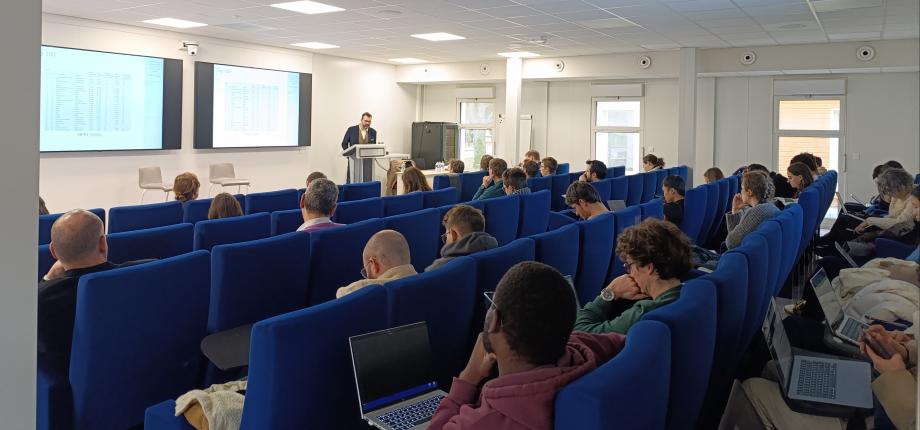
Participants from a wide range of backgrounds—including Master’s students, PhD candidates, postdoctoral researchers, academics, and staff from the French Ministries of the Armed Forces and the Interior—also benefit from this initiative. Through this training programme, Manuel Dorion-Soulié aims to equip participants with different analytical perspectives to help them navigate the complexities of the world around them, deepen their understanding of international relations, and develop a more informed perspective on the major issues shaping current affairs.
“I want to shed light on contemporary issues by taking a step back to consider them from a broader historical and conceptual perspective, while also demonstrating that rigorous approaches to international relations issues exist and deserve greater recognition.”
Programme overview
This training programme explores the history of the world’s major powers, from the United States to China and Russia, tracing their development from the beginning of the 20th century onwards. It also examines several key issues in international relations, including the defence industry, the geopolitics of space and the international monetary system. The sessions will take place over three Fridays, from 9 am to 5 pm: 8, 15 and 22 January 2027. Teaching will be delivered in French, but the course materials will be in English.
Friday 8 January
- American Hard and Soft Power in the 20th Century
Speaker: Manuel Dorion-Soulié – Assistant Professor of American Civilisation (École Polytechnique) - The Dollar, the International Monetary System and Sanctions
Speaker: Maylis Avaro – Economist (Trinity College Dublin)
Friday 15 January
- European Defence and the French Defence Industrial and Technological Base
Speaker: Julien Malizard – Economist (IHEDN) - Russia and the USSR from the Tsarist Empire to the Present Day
Speaker: Cédric Pernette – Senior Lecturer in Russian Language and Civilisation (Sorbonne University and École Polytechnique)
Friday 22 January
- The Geopolitics of Space in the 21st Century
Speaker: Lise Dubois – Political Science, ENS Ulm – CIENS - China and the International Economy since 1949
Speaker: Camille Brugier – Political Scientist (Institute for Strategic Research at the École Militaire (IRSEM))
Practical information
Who can attend? Students, PhD candidates, postdoctoral researchers and staff at IP Paris and its member schools, as well as staff from the French Ministry of the Armed Forces and Veterans Affairs and the French Ministry of the Interior.
Where? Auditorium at the X-Novation Center, École Polytechnique – Avenue Coriolis, 91120 Palaiseau, France.
Registration: Free of charge but compulsory. Please register by 18 December 2026. To register, send an email providing your SURNAME, first name, employer, job title and professional email address.
It is possible to attend individual sessions, although full participation is recommended. Please indicate any partial attendance when registering.
Testimonials from previous editions
Mariana Otoya, PhD candidate at the Solid Mechanics Laboratory at École Polytechnique in 2026:
“What struck me about this training programme was the diversity of topics covered, ranging from history and economics to defence issues, as well as the quality of most of the presentations and the richness of the discussions.”
Marie Cherasse, postdoctoral researcher at the Applied Optics Laboratory (LOA) at École Polytechnique in 2025:
“Historians and economists approach presentations and dialogue in different ways. I was curious to learn more about these different approaches. My research has civilian applications and could also have applications in the military sector. This training programme gave me additional motivation to contribute to France’s technological sovereignty.”
Rafaël Valente, Master's student in Data and Finance at École Polytechnique and HEC Paris in 2025:
“In politics, law and the social sciences, you start at point A and work towards point B. The structure used to develop an argument is quite similar to that of my own coursework. You need arguments and evidence to support your thesis. This training programme helps me better understand current political situations and conflicts, such as the war in Ukraine and conflicts in the Middle East.”