
CIEDS Research Themes

CIEDS primarily focuses on ten research themes:
Cybersecurity and Communications Security

As in the civilian world, the digitisation of most defence systems introduces unprecedented vulnerabilities. Secure, robust, and discreet telecommunications are also a major concern for the armed forces. Furthermore, the acceleration of operational tempo requires processing as close as possible to the sensors, which imposes new constraints on information sharing and distribution, as well as on the management of networked systems.
Detection of Biological and Chemical Threats and Medical Response

In operations, the armed forces are exposed to risks that are rarely encountered in civilian contexts. This theme aims to develop specific tools to address these challenges, whether related to nuclear, radiological, biological, and chemical threat agents, or to issues specifically concerning the health of soldiers (extreme conditions, emerging diseases, or trauma care).
Energy and Propulsion

The field of defence energetic materials (explosives, propellants, gas generators, etc.) is one where innovation is crucial to adapt to new economic and environmental constraints. Other challenges, such as the gradual electrification of vehicle fleets, will also have an impact on the defence sector. This theme aims to address some of these issues, notably through modelling and digital tools.
Environment, Observation, and Forecasting

In an operational context that spans multiple environments and domains, understanding areas of conflict is essential for armed forces to engage effectively. Operational contingencies may prevent the optimal use of force, making the implementation of tools for forecasting various meteorological phenomena crucial. The emergence of space and the deep oceans as potential areas of conflict further justifies the study of these environments.
Lasers, Photonics, and Quantum Technologies

Quantum technologies are expected to transform numerous sectors, including defence and security, notably through quantum sensors or, in the longer term, quantum computers. Alongside these studies on quantum technologies, this theme also leverages IP Paris’s expertise in laser science, with applications as diverse as non-destructive testing and shock generation.
Defence Innovation Management

The defence industry operates on cycles that are considerably longer than those in other industries. At the same time, it increasingly seeks to integrate and adapt components or systems developed for civilian applications. The technological development cycles of these civilian components and systems have tended to accelerate significantly since the 2000s. It is therefore essential to study innovation dynamics within large, multi-year armament programmes.
Materials, Structures, and Functionalisation
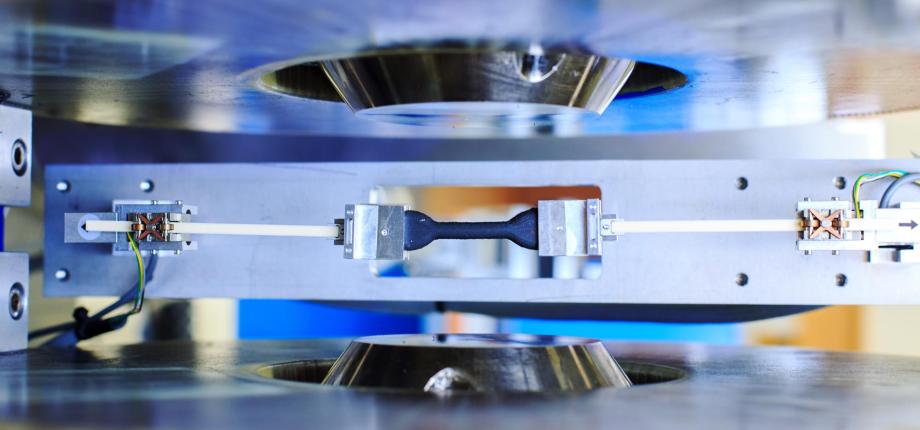
New materials and the architectured structures derived from them open up numerous opportunities for the defence industry. This theme aims to study the defence applications of new scientific processes or methods that are currently transforming the field, such as additive manufacturing, surface functionalisation and nanostructuring, or ab initio modelling.
Modelling, Simulation, and Imaging

A cross-cutting discipline within IP Paris and essential for security and defence, applied mathematics spans areas as diverse as modelling, simulation, engineering, behaviour analysis, and strategy. It lies at the heart of methods for optimisation under constraints on materials, shapes, structures, and networks. It also enables multi-scale simulation and the analysis of complex fluid flows, in hydrodynamics or energy applications.
Robotics and Artificial Intelligence

Artificial intelligence is a tool capable of addressing issues related to intelligence gathering, decision support in planning and control, or operational readiness. Robotics focuses on the development of systems in complex, unknown, and/or hostile environments, requiring capabilities in perception, orientation, multi-sensor data analysis, trajectory planning, and efficient navigation, at various levels of autonomy.
Defence Sovereignty and Strategy

Across all its activities, CIEDS has the overarching objective of developing sovereignty and strategic autonomy. This research theme aims to understand how the contemporary context and its frictions affect the conditions of national sovereignty and thereby contribute to major national technological orientations through systemic analyses.